
Bitcoin Cash Can Scale Exponentially and Support the Global Economy
 For well over a year now the Bitcoin Cash (BCH) protocol has shown quite a bit of capability as far as on-chain scaling is concerned. The creator of Bitcoin knew that the technology had to expand in scale quite vastly in order to accept the magnitude of global commerce and businesses on the blockchain. In the early days, Satoshi told people that the technology would follow alongside Moore’s Law with high-performance computing, and the past year has shown the BCH chain can scale to fulfill the needs of the global economy. Also read: Sales Tax and Bitcoin in the United States Can Be Confusing
Even Before Satoshi Nakamoto Launched the Bitcoin Network, the Creator Knew Blockchain Technology Could Scale
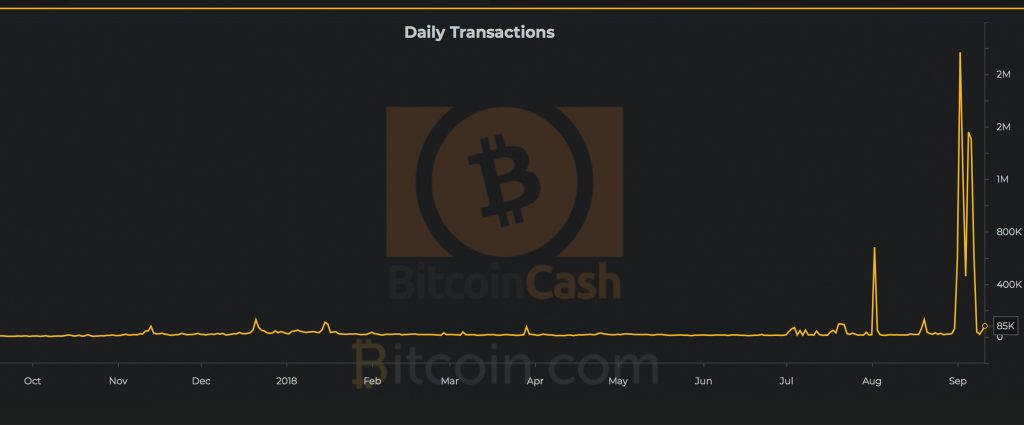
 For a while now there’s been a lot of confusion and purposeful manipulation spread by people who have said that Satoshi Nakamoto’s creation cannot scale. Since August 1, 2017, the Bitcoin Cash chain has consistently performed despite all the naysayers. In fact, like the rise in merchant adoption, the Bitcoin Cash protocol itself has recorded many scaling milestones this year. The size of the blockchain and block propagation speed has always been some of the excuses people like to use when they object to on-chain scaling. However, on November 2, 2008, Satoshi wrote about the growth of the chain and believed the technology would not only rely heavily on the Simplified Payment Verification model, but also follow right alongside Moore’s Law. “Visa processed 37 billion transactions in FY2008, or an average of 100 million transactions per day,” Nakamoto emphasized.
 That many transactions would take 100GB of bandwidth, or the size of 12 DVD or 2 HD quality movies, or about $18 worth of bandwidth at current prices. If the network were to get that big, it would take several years, and by then, sending 2 HD movies over the Internet would probably not seem like a big deal.
Take Notice: Society Now Has 7nm Semiconductors, New Phones That Can Process 5 Trillion Operations a Second, and 14TB Storage Drives for Only a Few Hundred Dollars
Gordon Moore the founder of Intel had a very good observation back in 1975 that has been fairly accurate when it comes to society’s technological advancements. Gordon’s original prediction started in 1965 when he said the number of transistors added to an integrated circuit would double every twelve months. But in 1975 he changed his forecast to the component cost of a semiconductor doubling every two years. Moore’s Law has been very accurate and many businesses and individuals base the speed and growth of computational scaling using his observation. Moreover, Moore’s law shows a fairly accurate assessment of not only how our technology is blooming but also how the BCH protocol itself can expand global scaling and maintain protocol affordability. However, blockchain storage has been used a primary excuse to stall scaling in the past even though semiconductor technology is improving vastly, central processing units and ram continues to grow more affordable, and storage space has been following the same path. One could even attribute the mining of cryptocurrencies towards the improvement of semiconductors. Moore’s law is still alive and well and it may be a hair behind the observation’s timeline of increased performance every two years, but it is still growing at an exponential rate.
The Need for a Higher Level of Bandwidth for Network Communication Has Driven Widespread Low Latency Fiber Optics Growth Worldwide
Another fallacy individuals like to use is block propagation delay or latency issues. This is the amount of time it takes for computer networks like the Bitcoin protocol to propagate blocks. However, latency is a really easy fix for any computer network by making adjustments to both the software and hardware specifications. The argument may apply to non-mining nodes using 56K modems, but with concepts like Fiber optical cables latency is really a non-issue.

The BCH Unspent Output Set Size is More Efficient Than BTC’s Set Size Today and Can be Improved Easily
To add to this excuse, another horrible reason people fight against on-chain scaling is because of so-called ‘uncontrollable’ UTXO set size growth. Individuals think the data from the unspent output (UTXOs) from bitcoin transactions could cause the UTXO set size to grow exponentially too large. However, BCH proponents are not worried about UTXO bloat as the UTXO set could easily be sharded, and right now the Bitcoin Cash protocol is consolidating unspent outputs in a more efficient fashion than the BTC network. This can be seen by quickly observing the UTXO set for BTC in comparison to the BCH set. Fortunately for BCH developers, there are more efficient methods of UTXO selection and there are plenty of concepts to test and determine which process works best.
The Bitcoin Cash Chain Is Proving on-Chain Scaling Can Work, While Other Blockchains Depend Heavily on the Concept of a New Network That Could Be Riddled With Security Vulnerabilities and Centralization


Images via Shutterstock, Statoshi.info, Pixabay, Wiki Commons, and Apple’s latest keynote.
At Bitcoin.com there’s a bunch of free helpful services. For instance, have you seen our Tools page? You can even look up the exchange rate for a transaction in the past. Or calculate the value of your current holdings. Or create a paper wallet. And much more. The post Bitcoin Cash Can Scale Exponentially and Support the Global Economy appeared first on Bitcoin News.
2.2M transactions per day 23MB Block Bandwidth Bank of England BCH bitcoin cash Bitcoin Core Bitcoin technology BTC Latency Massive Scaling moores law N-Featured Nielsen's Law on-chain scaling Op-Ed Opinion Processors Scaling Semiconductors UTXO Bloat


